Permit Guide · Reno, Sparks & Washoe County
Do You Need a Permit to Remove a Tree in Reno or Sparks?
Usually it comes down to one question: is the tree on your land, or in the public right-of-way? In Reno, trees on City property and in street planting strips need a City Tree Work Permit before they are pruned, removed, or planted. For a tree entirely on your own residential lot, neither the City of Reno nor Washoe County publishes a tree-removal permit requirement — though a few special cases (power lines, the Tahoe Basin, development landscape plans, HOAs) still apply. Here is what each jurisdiction's own pages say as of November 2026.
The Short Version
- Street tree or tree on City of Reno property: Tree Work Permit from the City's Urban Forester required before removal, pruning, or planting.
- Tree entirely on your own Reno or Washoe County residential lot: no residential tree-removal permit is published by the City of Reno or Washoe County. You are still responsible for the tree, and Reno can require you to remove one that is a public safety hazard.
- Sparks: confirm with the City of Sparks before working on any public tree — we could not verify the current Sparks rules for this guide (details below).
- Inside a Washoe County road right-of-way: Encroachment/Excavation Permit from the county's Engineering Division, and the work must be done by a licensed, bonded, insured contractor.
- Incline Village / Crystal Bay (Tahoe Basin): TRPA permit for live trees over 14 inches in diameter at breast height.
- Any tree touching or close to a power line: call NV Energy first, not a tree service.
City of Reno: Tree Work Permits for Public Trees
Reno's tree rules live in Reno Municipal Code Chapter 8.32 (Trees and Shrubs) and are administered by the Urban Forestry program in the Parks, Recreation and Community Services department. The City's own guidance says a Tree Work Permit is required before removing, pruning, or planting trees within City rights-of-way or on City property, and the code section it cites (RMC 8.32.040) also covers cutting or damaging roots. The permit is issued by the Urban Forester, is valid only for the job location it names, and an inspection happens before one is issued. Two limits matter for homeowners:
- Removal is not automatic. The City says it may not issue a permit to remove a tree unless the tree is dead, diseased, or poses a public safety hazard. "I'd like a clearer view" is not a reason the City recognizes for a public tree.
- Topping is prohibited on City trees. It is not an accepted practice and is not allowed.
The City also requires that the person doing permitted removal or pruning on a right-of-way tree hold a current International Society of Arboriculture (ISA) Arborist or Tree Worker certification — so a street-tree permit is in practice a job for a certified professional, not a weekend project. If a right-of-way tree in front of your house is the problem, start by calling the Urban Forestry Office, then get matched with insured Reno and Sparks tree removal pros who can tell you up front whether they hold the certification the permit requires.
Contact: City of Reno Urban Forestry Office, 775-321-8373 (inspections, permits, ownership questions, approved street-tree list). To report a hazardous tree, call Reno Direct at 775-334-4636.
Private trees in Reno: your tree, your responsibility
The City's tree FAQ is explicit that the City cannot perform any work on privately owned trees and does not remove trees on private property. It does not state a permit requirement for removing a tree in your own yard, and it says a certified arborist is not required for private trees (though the City highly recommends one). What the City does hold owners to:
- Owners are responsible for limbs from their trees that hang over streets, and for sidewalk damage caused by their own trees (the City budgets for sidewalk repairs only when a City tree caused the damage).
- Owners must maintain their trees so they do not endanger public travel or block traffic signs, signals, and intersection sight lines, and must remove dead trees or limbs that create such a hazard.
- The City may require a property owner to remove a private tree that poses a public safety hazard.
One honest caveat: the City of Reno has been revising Chapter 8.32. A redlined draft went through Urban Forestry Commission meetings and a public workshop in summer 2026, with City Council readings still ahead before adoption. The City describes the update as modernizing and clarifying the maintenance and protection of public trees. Check the City's Urban Forestry page for the current version before relying on any summary, including this one.
How to tell whether a tree is in the right-of-way
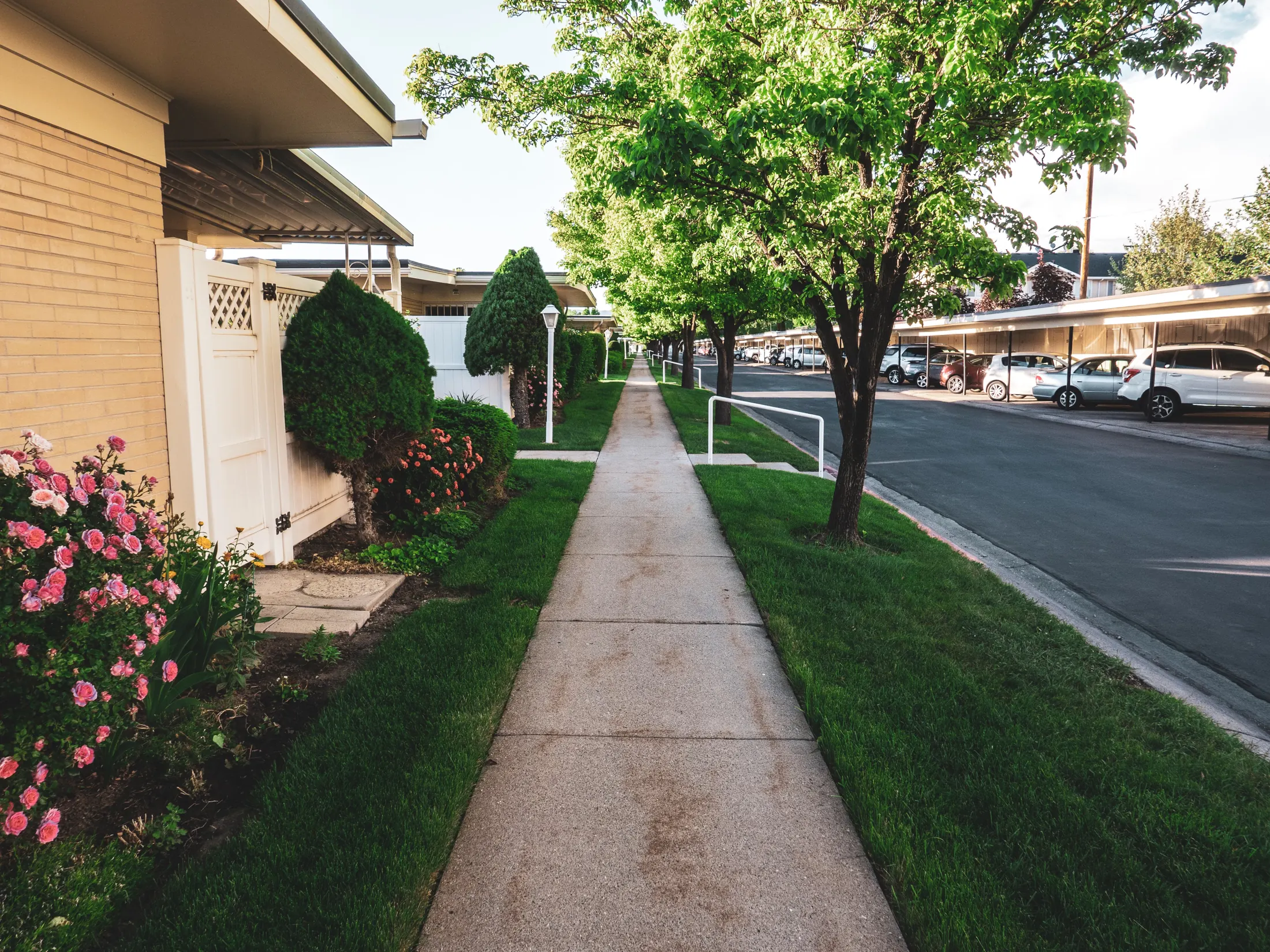
In Reno, the planting strip between the curb and the sidewalk (the "parkway") is public right-of-way, and the City's street-tree guidelines note the right-of-way may extend behind the sidewalk or curb where there is no planting strip. A fence line is not a reliable boundary marker. If you are not sure, the Urban Forester's office can help determine ownership, and our guide to who owns a tree on the property line covers the neighbor-to-neighbor side of the same question.
City of Sparks: Confirm With the City First
Sparks has its own municipal code chapter on public trees (Title 12, Public Improvements, includes a chapter titled Urban Forestry). We were not able to reach the City of Sparks' website to read the current text while preparing this guide, and we would rather defer than paraphrase a city ordinance from secondhand summaries. Treat Sparks the way you would treat Reno — assume a tree in a street planting strip, park, or other public area is the City's and needs City approval before anyone prunes or removes it — and confirm the specifics with the City of Sparks Parks and Recreation Department (or Public Works, for right-of-way questions) before work starts. For a tree entirely on your own lot, ask the same office whether any approval applies; do not assume.
Unincorporated Washoe County
Outside the two city limits — Spanish Springs, Sun Valley, Washoe Valley, Cold Springs, the Mt. Rose corridor, and so on — Washoe County does not publish a general residential tree-removal permit. Three county-level rules can still touch a tree job:
- Work in a county road right-of-way. The county's Community Services Department requires an Encroachment/Excavation Permit before any work within the Washoe County right-of-way, and the permittee must be a contractor that is licensed, bonded, and insured to work in Nevada (or a utility). A Revocable Occupancy Permit is required before placing any obstacle or encroachment in the right-of-way in unincorporated areas. Contact CSD Engineering and Capital Projects at 311 (inside Washoe County) or 775-328-2003, 1001 E. Ninth Street, Reno.
- Development landscape plans. The county's Development Code landscaping article (Article 412) governs landscape plans for development projects. The county's ordinance record for that article addresses preserving significant existing trees on a project site, replacing significant trees that must be removed, and keeping required landscaping maintained and replaced by the owner. Its exemption language excludes the ordinary front, side, and rear yard areas of detached single-family lots, so a typical house lot is not what the article is aimed at — but a tree on commercial, multifamily, or common-area land that was planted or preserved to satisfy a landscape plan should be cleared with CSD Planning and Building before removal.
- Incline Village and Crystal Bay. The Lake Tahoe Basin portion of Washoe County is also under the Tahoe Regional Planning Agency. TRPA's own page says a permit is required to remove live trees greater than 14 inches diameter at breast height (and smaller trees in some sensitive locations, such as between a house and the lake or in a stream environment zone), while removal of a dead tree that could fall on a house does not require a permit. Tree removal for defensible space can be permitted by the local fire protection agency. TRPA Forester: 775-589-5294.
Trees Near Power Lines: NV Energy, Not a Contractor
This is the rule that matters most for safety, and it applies in every jurisdiction above. NV Energy prunes trees that grow too close to the high-voltage lines that run between poles, using its own trained staff and selected contractors, and it asks property owners and tree-service professionals to report trees that are close to or touching those lines rather than work on them. Trees do not have to be touching a line to need pruning — the required clearance grows with voltage. The one line NV Energy puts on the property owner is the electric service drop from the pole to your house: it is your responsibility to keep trees clear of it.
If any part of the tree you want trimmed or removed is near a line, call NV Energy's Northern Nevada tree pruning request line at 775-834-4444 (or submit at nvenergy.com/tree) before you book anyone else. Once NV Energy has cleared the line side, routine tree trimming and pruning on the rest of the canopy is a normal job for a matched local pro.
Storm Damage and Emergencies
In an emergency, the City of Reno says its crews may clear an obstruction from the right-of-way regardless of who owns the tree. A tree down on your roof, car, or fence is your call to make, and the permit question largely falls away for a tree that is already on the ground — but the power-line rule does not. If a fallen tree has taken a line down with it, stay clear and call NV Energy's outage line first. For everything else, our storm and emergency tree removal page covers what to do in the first hour and how emergency pricing differs from a scheduled job. After a wind event, be wary of door-to-door crews pressing for cash work on the spot.
Licensing: What Nevada Actually Requires
Nevada licenses contractors through the Nevada State Contractors Board (NSCB), but there is no license classification specific to tree removal or trimming. The nearest fit is C-10 Landscape Contracting, whose scope under NAC 624.280 includes planting and maintaining "shrubs, vines, bushes, trees and other vegetation." The Board's own exemptions page says a contractor's license is not required for work to repair or maintain property valued at less than $1,000 including labor and materials, with exceptions (for example, where a building permit is required or the work is of a type done by a licensed classification). In practice many dedicated tree services in the Reno area operate without an NSCB license, which is why this site's hiring guide leans on insurance verification rather than a license number. If a company tells you it is licensed, confirm it by name at the NSCB public license lookup; if it does not claim one, ask for a current certificate of general liability insurance before any cutting starts.
After the Tree Is Down: Stumps and HOAs
None of the city or county pages above treat stump removal differently from the tree itself — a stump in the right-of-way is still a right-of-way matter, and a stump in your yard is yours. Where it does get its own line item is the quote: stump grinding in Reno and Sparks is usually priced separately from removal, so ask whether it is included. And before you call anyone, check your HOA's governing documents: many Reno/Sparks-area associations require architectural review for removing a tree even when no public agency does. For what the whole job tends to run, see our Reno tree service cost guide. Properties near the foothills should also read our defensible space guide, since fire-agency clearance recommendations can change which trees come down first.
How We Vet Every Matched Pro
A permit is only half the question — the other half is who does the work. Every pro we match you with has verified general liability insurance, and we note ISA certification where a pro holds it, which is what Reno's own street-tree permit requires.
- Active general liability insurance — verified before we match you with a pro, not taken on their word.
- Real local coverage — matched pros actually service Reno and Sparks, not a call center routing to whoever's available nationally.
- Credentials noted where held — ISA certification or TCIA accreditation, when a pro carries them, factors into who we match you with. Nevada has no contractor-license classification specific to tree work, so this is a meaningful signal, not a formality.
- No obligation — getting matched and getting a quote doesn't commit you to hiring anyone.
Frequently Asked Questions
Do I need a permit to remove a tree in my own yard in Reno?
Who decides whether my street tree is the City’s or mine?
Can the City of Reno refuse a permit to remove a street tree?
Does Sparks require a tree removal permit?
What about trees in unincorporated Washoe County?
A tree is touching the power line — who do I call?
Does a tree company in Nevada need a contractor’s license?
Not Sure Whose Tree It Is? Get It Looked At by an Insured Local Pro
We match you with an insured local tree pro — we don’t perform the work ourselves.